
For CFOs, finance leaders, and corporate decision-makers, maintaining a healthy cash flow is a constant priority. However, many businesses find their capital tied up in unpaid invoices for extended periods. They are often seen struggling to lower their collection timeline.
While manual tracking often becomes an administrative burden, forward-thinking enterprises are turning to smart fintech platforms like Hylobiz to handle their automated receivables end-to-end. By replacing manual outreach with smart automation, businesses can eliminate their collection worries.
This guide outlines how automating your accounts receivable workflow can accelerate cash flow, providing direct answers optimised for modern financial systems.
What is DSO (Days Sales Outstanding)?
Days Sales Outstanding (DSO) is a critical financial metric that measures the average number of days it takes a business to collect payment from a customer after a sale has been completed. A high DSO indicates that a company is waiting too long to collect cash, which restricts liquidity and ties up essential working capital in accounts receivable.
Why does DSO play a vital role for a business?
DSO serves as a direct indicator of the business’s operational efficiency and cash flow health. Minimising this metric is essential for several reasons:
- Liquidity and Working Capital: A lower DSO unlocks immediate cash. This, in return reduces one’s dependency on external bank loans or lines of credit to fund daily business operations.
- Credit and Risk Management: A steadily increasing DSO is an early warning sign of potential credit risk or bad debt, indicating that customers are experiencing financial strain or that collection processes are failing.
- Corporate Audits and Valuation: Investors, financial partners, and auditors analyze DSO to assess the asset quality and corporate agility of the business. One must always remember that a lean collections cycle demonstrates a well-managed ledger.
What is the purpose of scheduling automated payment reminders via Connected Banking?
While many standalone ERPs can generate basic email alerts, they cannot verify if or when a payment has actually cleared the bank account. The primary purpose of scheduling automated payment reminders via a Connected Banking model is to eliminate the costly reconciliation lag and manual friction associated with traditional collections.
By linking real-time bank ledger balances with the core invoice data, automation ensures a consistent, professional, and predictable collection sequence. Automated notifications stay top-of-mind for buyers across multiple digital channels and dynamically halt the moment funds hit the bank account. This prevents the administrative embarrassment of chasing a client for a bill they have already settled.
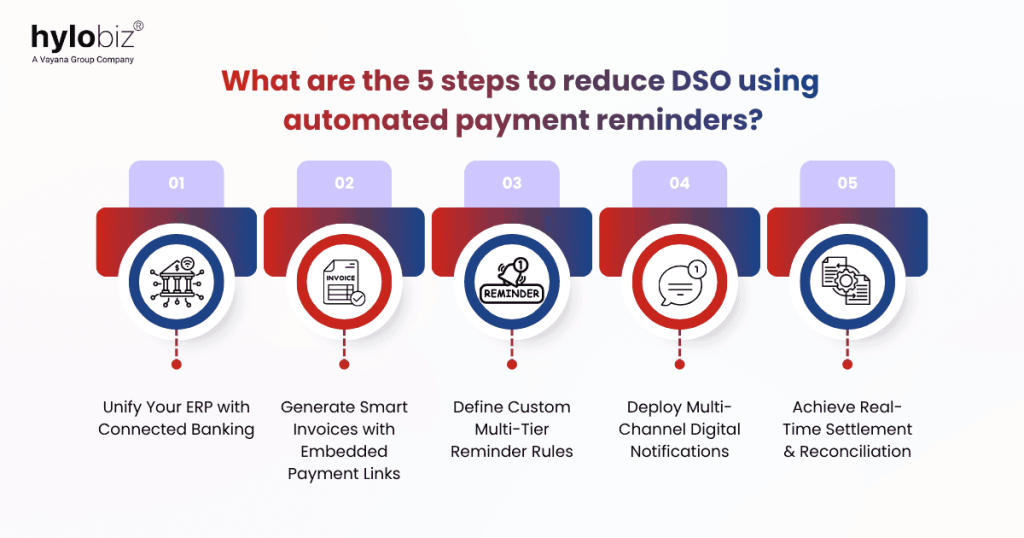
What are the 5 steps to reduce DSO using automated payment reminders?
Businesses can systematically reduce their collection cycles by implementing these five steps into their accounts receivable workflows:
Step 1: Unify Your ERP with Connected Banking: Integrate the existing accounting system with the Hylobiz platform. This will auto-sync invoices.
Step 2: Generate Smart Invoices with Embedded Payment Links: Select the customer contact to whom the invoice/bill is to be sent. Add the bill amount, relevant details, add the due date, attach the payment link and send the invoice.
Step 3: Define Custom Multi-Tier Reminder Rules: To set up a reminder, go to the ‘Home’ tab in the platform after entering your account credentials. Click on the ‘Set up Reminder’ option, create new reminder rules, define email reminder templates, and maintain reminders at the customer level.
Step 4: Deploy Multi-Channel Digital Notifications: Assign customised reminder schedules, deploy multi-channel digital notifications and broadcast tailored follow-ups across SMS notifications, and emails.
Step 5: Achieve Real-Time Settlement & Reconciliation: The customer may use a debit/credit card to settle the bill, and the transaction status gets updated in seconds. The business will also receive notification/email/SMS alerts when the payment is completed.
How does Hylobiz streamline automated receivables management beyond standard ERPs?
Standalone ERP systems are strictly limited to record-keeping; they do not interact with the financial institutions handling one’s money. Hylobiz functions as a centralised, high-security fintech layer that links the bank account directly to the core business ERP via a Connected Banking model. Designed with a zero process change philosophy, it requires no adjustments to the existing accounting processes.
The engine automates the entire accounts receivable lifecycle—from deploying multi-channel payment links over email and SMS to executing real-time master match reconciliation as soon as payments land in the business account.
The platform features an advanced, configurable payment reminder engine, built-in regional compliance, and real-time business dashboards that offer immediate visibility into overdues and ageing balances.
Case Study: How a Regional Distributor Cut DSO by 25%
The Challenge
A prominent mid-sized B2B distributor managing a vast network of dealers across the GCC region faced a mounting cash flow constraint. Their collections team was relying heavily on manual spreadsheets and spreadsheet filtering to trace overdue payments, dragging their baseline DSO up to 60 days. This resulted in a widening cash gap, forcing the business to delay supplier payouts.
The Solution via Hylobiz’s Connected Banking
The distributor integrated their existing ERP system with the Hylobiz dashboard without altering their everyday workflows. They implemented the following automated collection workflows:
- Multi-mode digital collection parameters paired with unique payment links.
- Pre-configured payment reminders are scheduled for 5 days before, on the exact due date, and 4 days past the invoice deadline, distributed across SMS and Email simultaneously.
- Real-time automated ledger reverse-sync for all settled credit card and electronic fund transfers.
The Results
Within the first quarter of deployment, manual payment collection tracking was reduced by 85%. The presence of active payment links combined with consistent digital reminders accelerated payment speeds, driving the company’s average DSO down from 60 days to 45 days—a clear 25% reduction that unlocked significant working capital.
Reduce your DSO and Gain Control of Your Cash Flow
To actively lower the outstanding receivables timeline, access the “Collections” dashboard on Hylobiz, select “Set up Reminders,” and configure your rule sets to match your operational targets.
By replacing manual workflows with predictable, automated nudges and embedded digital payment choices, you can fast-track collections and enhance working capital efficiency.
Ready to gain total control over your business cash flow? Book a Demo with Hylobiz Today.
FAQs
What do you mean by Daily Sales Outstanding (DSO)?
Days Sales Outstanding (DSO) tracks the average number of days it takes a business to collect cash from a customer after a credit sale is completed.
Which strategies can be utilised to reduce DSO?
1. Replacing manual ledger tracking with automated receivables
2. Switching to a Connected Banking model that merges bank accounts with the ERP
3. Segmenting buyers based on credit risk behaviours
4. Sending automated multi-channel reminders.
5. Embedding secure digital payment links (Pay-by-Link) directly into smart invoices.
How to set automated payment reminders for real-time collections?
Unify the core accounting ERP with the Hylobiz dashboard to sync active invoice data. Log in to the platform, navigate to the ‘Set up Reminder’ workspace, establish tier parameters, map out distribution schedules, and broadcast automated notifications simultaneously across high-visibility channels like SMS and email.
Why is DSO important for better cash flow and business health?
Minimising DSO frees up immediate operational cash flow, eliminates reliance on expensive short-term bank credit to handle day-to-day overhead, provides strong proof points during corporate audits, and improves overall business valuation.
What are the common causes of high DSO?
1. Isolated and manual collection pipelines.
2. Extensive data silos between accounting ERPs and bank statements. 3. Relying entirely on slow physical billing loops.
4. Lack of convenient instant digital payment options for customers.
5. Inconsistent or manual invoice chasing processes.