
The CFO of a mid-size trading group is waiting for the month’s collection summary. The finance team is compiling it manually by pulling bank statements, cross-referencing against ERP records, flagging unpaid invoices, and updating the master tracker.
Studies show that finance professionals spend up to 20 hours every week on manual invoice processing. Manual collections processes typically add 15 to 30 days to DSO, tying up working capital that could be fuelling growth.
There is a better way. UAE corporates are increasingly finding this through Connected ERPs; a model that links the ERP directly to banking, collections, and compliance. By leveraging specialised B2B fintech solutions like Hylobiz, regional businesses are converting static back-office systems into an active, intelligent, real-time financial command centre.
What is a Connected ERP?
A secure, API-driven connection between a company’s ERP and its banking infrastructure, collections engine, payment channels, and compliance workflows is known as a connected ERP. It turns the finance function from a reporting engine into a collections engine, working continuously, automatically, and without human intervention at every routine step.
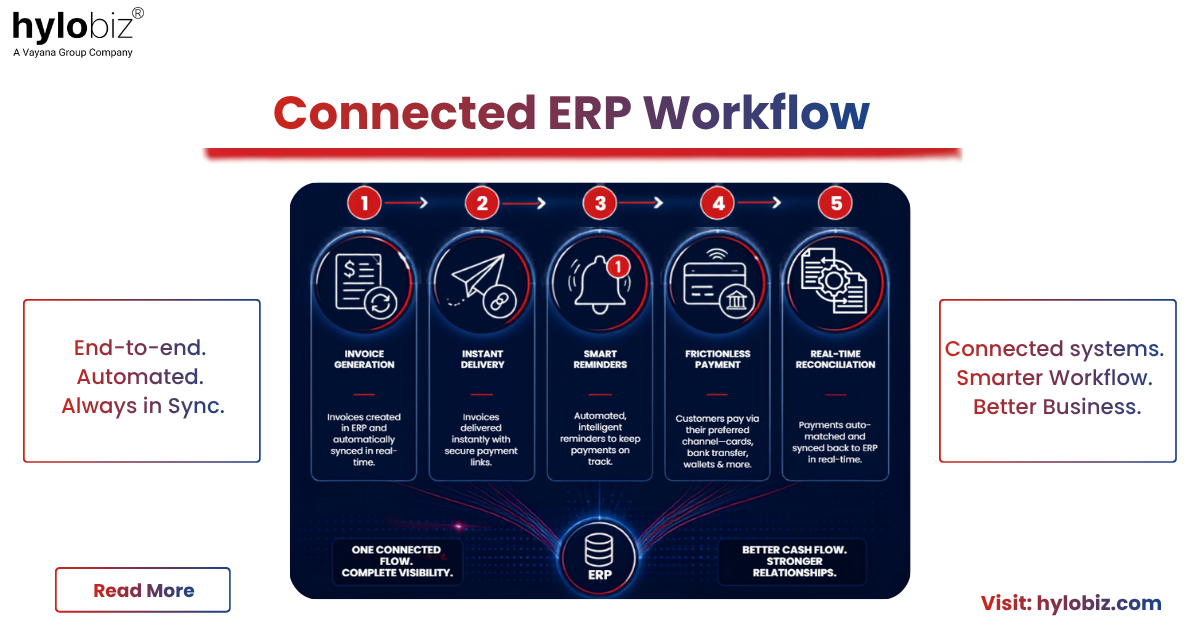
Connected ERP Workflow
- Invoice Generation: An invoice is created inside the primary ERP system.
- Instant Delivery: The invoice is automatically dispatched to the buyer embedded with dynamic, direct payment links.
- Smart Reminders: Rule-based nudges fire automatically via SMS and Email on a configured schedule.
- Frictionless Payment: The buyer pays via card, bank transfer, virtual account, or cheque.
- Real-Time Reconciliation: Through platforms like Hylobiz, payments are instantly matched to the correct invoice, automatically performing a reverse sync to update the ERP ledger in real time.
Disconnected ERPs: Complaints from the Finance Leaders’ Desk
Modern enterprises operating across the UAE and regional markets face three primary operational drains when relying on traditional accounting platforms:
1. DSO That Will Not Come Down:
When invoices are distributed manually, reminders are inconsistent, and payment confirmation takes days to reach the ERP, the cash conversion cycle stretches far beyond. Thus, a DSO of 45 to 90 days is common across GCC corporates.
2. Reconciliation That Consumes the Finance Team:
For businesses handling hundreds or thousands of monthly invoices across multiple payment methods, reconciliation is a periodic manual exercise that involves matching transactions, resolving discrepancies, and updating ledgers. Without a real-time connection between the bank and ERP, the reconciliation process continues for several working days each month, leading to errors, delays, and audit risk.
3. Zero Visibility Until It Is Too Late:
Manual reporting cycles mean cash position data is always historical. A CFO reviewing last week’s collections numbers to make today’s investment or supplier payment decision is flying with a delayed instrument panel. In a fast-moving business environment, that lag carries real financial consequences.
How Hylobiz Powers the Connected ERP Shift for UAE Corporates?
To overcome these structural hurdles, enterprises deploy B2B fintech engines to upgrade their existing setup. By integrating platforms like Hylobiz, UAE corporates solve critical operational struggles through several core features:
- ERP Connect: Using secure, bi-directional API connections, invoices, delivery notes, and supporting documents flow out automatically, while payment confirmations and ledger updates reverse-sync in real time.
- Invoice Management: Invoice creation, distribution, real-time acceptance, and escalation are managed digitally. Invoices reach buyers instantly with embedded payment links. Tier-2 network Tier-2 distributor networks can receive, view, and act on invoices directly within their digital workflows.
- Smart Payment Reminders & SOA: Configurable rules automatically dispatch payment reminders and Statements of Account (SOA) to buyers across email and SMS before, on, and after the due date.
- Unified Collections Hub: Payments across credit/debit cards, net banking, virtual accounts, cash, and cheques are unified into a single hub. Field collections made via cash or cheque are logged instantly on mobile devices with live digital receipts.
- Real-Time Dashboard & Strategic Insights: Finance leaders, accounts teams, and management can all access the same live view of total collections, outstanding balances, DSO by buyer, ageing buckets, payment behaviour analytics, and settlement status across all channels.
- Record Keeping & Audit Trail: Supporting documents such as delivery challans, purchase orders, and signed acknowledgements are correlated digitally with source invoices and stored with a full audit trail. For businesses managing regulatory compliance and supplier audits, this eliminates a persistent documentation headache.
- Purchase Order Tracking: Stock replenishment requests from distribution networks are managed through a structured digital workflow, giving Tier-2 partners real-time stock visibility and the ability to place system purchase orders, streamlining fulfilment and reducing communication friction across the supply chain.
Case Study: Connected ERP in Action for an FMCG Distributor
The FMCG Distributor That Took Back Control of Its Cash Flow
A mid-sized FMCG distributor based in Dubai supplies packaged goods to 120 retail and wholesale accounts across the UAE and Oman. With a diverse buyer base from hypermarkets to independent grocers, the invoice volumes run into the hundreds every month, across a mix of payment terms ranging from 30 to 60 days. Until recently, the company’s accounting system and its bank lived in entirely separate worlds.
The Problem
- Invoices were exported from the accounting system as PDFs and sent manually by email. This took the Accounts Receivable (AR) team several hours every day. Payment reminders were sent inconsistently, and many buyers simply waited for a second or third nudge before paying.
- Payments arrived across bank transfer, cheque, and card with no automatic matching. Reconciliation was a weekly exercise that regularly surfaced discrepancies requiring investigation.
- DSO had crept up to 52 days; not because clients were defaulting, but because the collections process made delay frictionless.
- The CFO had no live view of outstanding balances. Weekly cash position reports were available, but they were compiled from ERP data that was already 3 to 5 days out of date.
The Solution
The company connected its accounting system to Hylobiz’s Connected ERP platform. Integration took under two weeks. Since go-live, invoices auto-synced from and were distributed electronically to buyers with embedded payment links.
A reminder rule was configured per buyer category: hypermarkets received reminders at 7 days pre-due, 3 days pre-due, and on the due date; independent accounts received daily reminders from the due date onward. All payments, bank transfer, card, or cheque flowed into a single reconciliation hub and synced back to the accounting system automatically.
The Impact Within One Quarter
- DSO fell from 52 days to 29 days, a 44% reduction was witnessed.
- On-time payment rate improved from 51% to 79%.
- AR team’s manual invoice distribution time: eliminated.
- Reconciliation moved from a weekly 2-day exercise to a continuous, real-time process.
- Overdue invoices beyond 60 days reduced by 75%.
- The CFO now reviews a live dashboard every morning.
- Estimated AED 1.4 million in working capital unlocked from previously trapped receivables in the first quarter.
Why are CFOs Prioritising Connected ERP Now?
The return on a Connected ERP matters most to finance leadership:
- Accelerated Cash Flow: Faster invoice delivery, automated reminders, and multi-mode payment options compress the invoice-to-cash cycle significantly. Businesses using Hylobiz’s connected ERP automation consistently reduce DSO by up to 40% within the first quarter.
- Working Capital Released: Every day of DSO reduction is working capital returned to the business. For a corporation with AED 50 million in annual revenue and a 45-day DSO, each 10-day reduction in DSO frees approximately AED 1.4 million in cash.
- Finance Team Redeployed: When invoice distribution, chasing, and reconciliation are automated, finance teams can stop doing administrative work and start doing financial work, such as analysis, forecasting, risk assessment, and strategic planning.
- Real-Time Decisions: A live dashboard replaces the weekly report, meaning cash position decisions, credit extension calls, and supplier payment timing are all based on what is true right now.
The Switch Towards Connected ERP Is Already Happening
UAE corporates are not switching to Connected ERPs because it is a trend. They are switching because the alternative fragmented systems, manual collections, delayed visibility, and growing compliance pressure are becoming operationally and financially unsustainable.
The finance function has always been expected to do more with less. Connected ERP is what makes that possible without burning out the team or accepting a degraded view of financial reality.
In a competitive GCC market, the companies that move now will have 12 to 24 months of operational advantage over those that wait.
For CFOs and finance leaders evaluating this shift: the infrastructure is available, the deployment is faster than you expect, and the ROI is measurable from the first quarter. The only remaining question is how long your business can afford to operate without it.
How does a Connected ERP differ from traditional ERP software?
A traditional ERP acts primarily as a static, internal system of record that requires manual entry for bank statements and payment updates. A Connected ERP uses API integrations (such as those provided by Hylobiz) to connect directly with banks, digital payment gateways, and communication channels, enabling real-time automated payment processing and ledger updates.
Can Hylobiz integrate with existing accounting software of enterprises?
Yes. Hylobiz provides pre-built, secure API connectors that integrate directly with major accounting and enterprise systems and custom ERPs enabling automated invoice syncing and real-time reverse reconciliation without needing custom code.
How does automated payment link reconciliation work?
When an invoice is generated, a unique, dynamic payment link is attached. When the buyer pays via card, bank transfer, or digital wallet, the system automatically matches the transaction ID to the specific invoice number and updates the status to “Paid” in the ERP ledger instantaneously.